If the goal was to race a route, the clock deserves a large say. If the goal was a gentle aerobic run, arriving home faster because the final half became hard may be a worse execution of the plan, even when it produces a personal best.
Outcome and execution answer different questions.
Outcome asks what happened: finishing time, average pace, position or personal best. Execution asks how it happened and whether that method matched the purpose of the session.
Neither view replaces the other. A race result without execution detail gives you little to repeat. Execution without an outcome can become vague. The useful review holds both at once.
Your best-executed run is the one that most closely delivered the intended effort and pacing for that day, using the conditions and route you actually encountered.
Begin with the purpose of the run.
You cannot judge execution fairly if the workout had no stated intent. Before comparing the result, place the run in one of these broad categories:
- Easy or recovery: control the effort and finish able to continue.
- Steady aerobic: sustain a purposeful but manageable load.
- Hard or threshold-oriented: spend meaningful time at a demanding effort without turning the opening into an uncontrolled sprint.
- Race or time trial: produce the best sustainable outcome for the route and conditions.
- Exploration or social: record the experience without pretending pace was the goal.
A pace that is excellent for a time trial may be plainly wrong for a recovery run.
Read the shape, not only the average.
Compare the opening, middle and finish. An even or deliberately progressive effort often tells a cleaner story than a fast opening followed by a large fade. That does not mean even pacing is universally correct for every distance or course. Hills, tactical racing and workout design can all require variation.
A 2026 analysis of 78,912 Boston Marathon finishers found that even pacing was associated with faster finish times across the studied groups, while highly variable pacing had the highest incidence of a severe late slowdown. That is marathon evidence, not a rule for every five-kilometre run, but it shows why the distribution of effort matters.
A smaller controlled study found that head-to-head competition changed recreational runners' strategy: they started faster, finished a 3-kilometre effort faster and reported lower post-run vigour. The quickest outcome came with a different pacing and subjective cost.
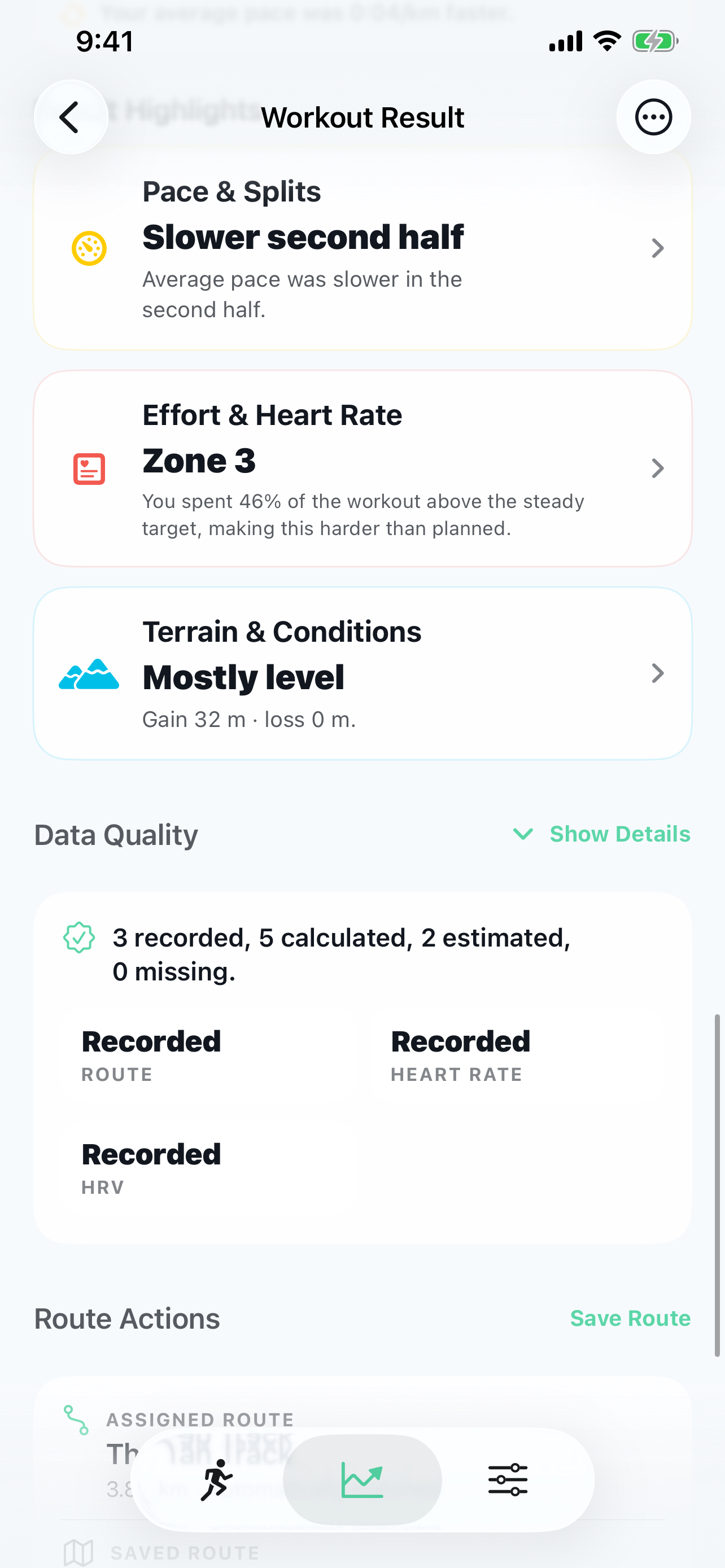
Use five checks for a better review.
1. Did the effort match the goal?
For an easy run, a lower pace at controlled effort may be a better result than a faster high-zone finish. For a hard session, spending too little time near the intended effort can make a comfortable run a poor match despite tidy pacing.
2. Was the opening sustainable?
Look for evidence that the first section borrowed too heavily from the finish. A recurring late fade after aggressive openings is more actionable than a generic instruction to "try harder next time."
3. Where did the route change the demand?
Locate climbs, descents, turns and familiar difficult sections. Slowing on an uphill section is not automatically poor execution. Holding flat-ground pace at a much higher cost may be the less controlled choice.
4. What did the effort cost?
When reliable heart-rate data exists, compare zones, average heart rate and the pattern through the workout. Treat heart rate as context rather than a verdict: heat, fatigue, sensor quality and normal day-to-day variation can all affect it.
5. Could you repeat the approach?
A good execution leaves a clear lesson. Perhaps the controlled climb protected the finish, or a calmer first kilometre reduced the usual late fade. If the only lesson is that you tolerated more discomfort, the time may still be excellent, but the plan for next time remains incomplete.
Conditions can change what good execution looks like.
Temperature, humidity and wind alter outdoor performance. Large observational studies have found associations between hotter conditions and slower marathon outcomes, although no weather adjustment can perfectly explain an individual run. On a hot day, holding the same effort at a slower pace may represent disciplined execution rather than lost fitness.
Use conditions to set expectations and explain plausible differences. Do not use an estimated weather value to prescribe fluid intake or override how you feel.
Finish with one coaching sentence.
A useful review should be short enough to remember. For example:
- "The time improved, but the easy goal became hard after halfway; keep the opening effort lower next time."
- "You were slower in the heat, but effort stayed controlled and the usual final fade was smaller; repeat that pacing pattern."
- "Most of the loss came on the familiar climb at similar heart rate; shorten the stride there and rebuild pace after the crest."
- "This was faster at similar effort, with no new fade section; the improvement looks repeatable."
This is the difference between extracting highlights and coaching the next action.
How Trail IQ applies this idea
Trail IQ keeps the workout goal, same-route outcome, section changes, terrain, available conditions and optional heart-rate evidence separate before forming its review. It can then describe whether the run matched its purpose and suggest a specific next action without presenting fitness guidance as medical advice.
Explore Trail IQ's route and workout features.