Two runs can finish with the same average pace and tell completely different stories. One may be evenly controlled. The other may begin too quickly, lose time on a climb and recover through the final kilometre. The average is correct in both cases, but it is not a complete explanation.
Average pace compresses the workout.
Average pace divides time by distance. That makes it useful for a quick summary, but the calculation deliberately removes detail. It does not tell you where the pace changed, whether the route climbed, how long you stopped, what the weather was doing or how hard the pace felt.
This matters when comparing unrelated runs. A flat five-kilometre path and a rolling five-kilometre loop may have the same distance but place different demands on the runner. Laboratory work confirms that the energetic and mechanical cost of running changes with slope, and that uphill running capability cannot be inferred cleanly from level running alone.
Do not ask only, "Was I faster?" Ask, "Where did the result change, what did the route ask there, and what effort did it cost?"
A repeated route removes one large variable.
Returning to the same route gives the comparison a stable shape. The climbs arrive in the same places. Corners, surfaces and road crossings are broadly familiar. Distance is less likely to explain the difference by itself.
That does not make every attempt identical. GPS tracks vary, traffic interrupts, surfaces change and the weather still matters. A large analysis of Berlin Marathon results found associations between environmental conditions and pace, while also finding that weather variables explained only part of the variation. Conditions are useful context, not a universal explanation for every slower run.
Compare in layers.
1. Confirm that the attempts belong together
Start with the same route and the same activity type. Do not use a walk as the performance baseline for a run. Check that both recordings cover the intended route and that neither has an obvious GPS or timing problem.
2. Read the outcome
Look at elapsed time and average pace. This is the answer at the widest level: faster, slower or broadly similar. Keep it, but do not stop there.
3. Find where time moved
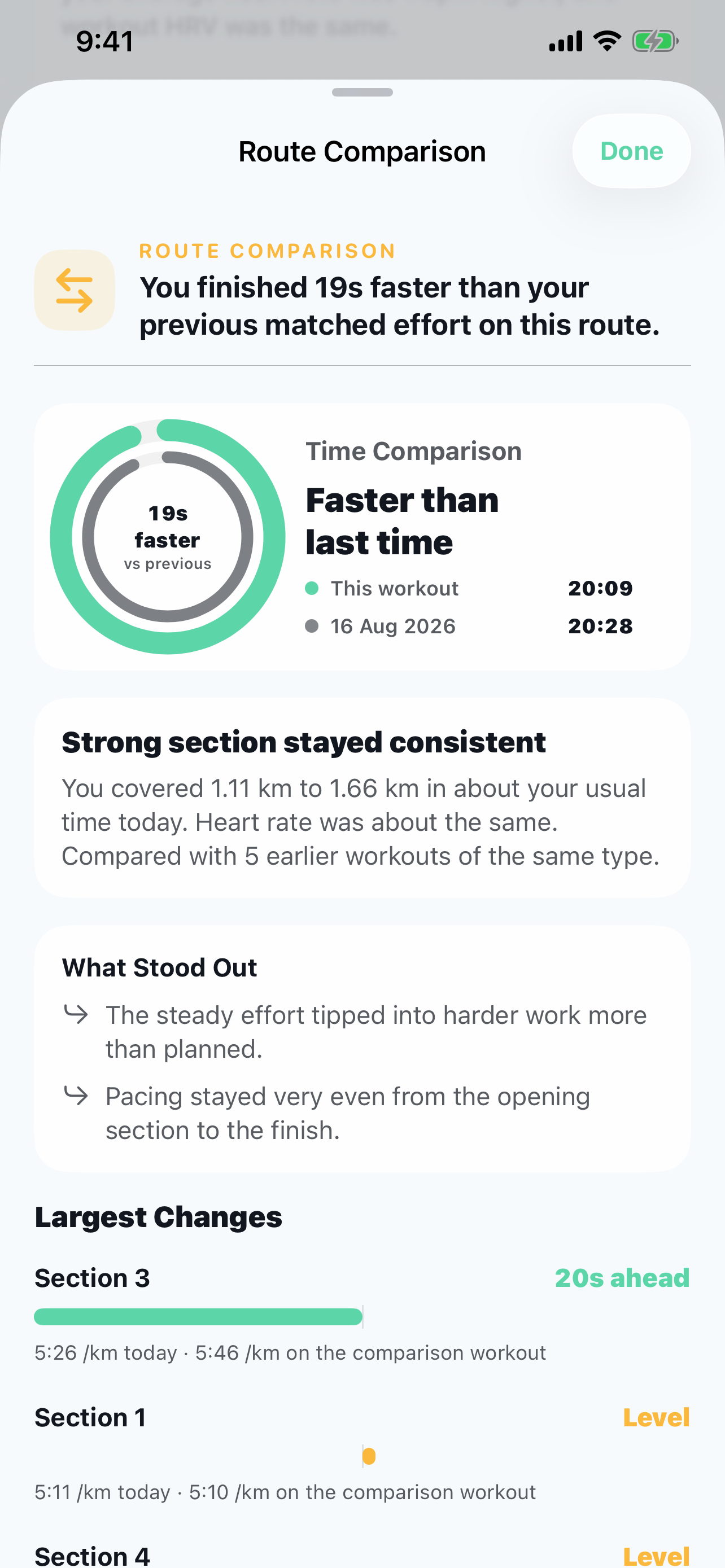
Compare splits or route sections. Did most of the change occur on the climb, through a normally difficult middle section, after a stop, or across the whole route in small amounts? One concentrated loss suggests a different next action from a gradual fade.
4. Add terrain and conditions
Check elevation change and the location of climbs or descents. Then consider temperature, humidity, wind and surface conditions when available. These factors should qualify the interpretation rather than automatically excuse or celebrate the result.
5. Add effort
If reliable heart-rate data exists, compare the cardiovascular cost alongside pace. A faster run at a similar average heart rate may suggest a different story from a faster run achieved with much more time in high zones. Heart rate can also drift during a sustained effort, so inspect its shape rather than treating one average as perfect truth.
6. Look for repeated evidence
One slow section may be a road crossing. The same fade appearing across several clean attempts is more useful. Repeated patterns help distinguish a route characteristic or pacing habit from a one-off interruption.
Turn the comparison into one practical action.
A good review should finish with a small decision, not a longer list of metrics. Depending on the evidence, that action might be:
- Begin slightly easier so the familiar late fade is less severe.
- Hold effort steady on the climb and recover speed after the crest.
- Repeat the route in more comparable conditions before drawing a fitness conclusion.
- Keep the same pacing approach because the result improved without a large increase in effort.
- Ignore a noisy section because GPS quality or an interruption makes it unreliable.
The purpose is not to make every run faster. It is to make the next attempt more informed.
How Trail IQ applies this idea
Trail IQ groups matching workouts of the same activity type on a familiar route. Route Memory can use best, latest and typical history, recurring route sections, terrain, available conditions and optional heart-rate context before, during and after the workout. The live Ghost is optional; post-workout route comparison does not depend on displaying it.
See how Trail IQ compares workouts on the same route.